 Omega Market Review
Omega Market stands out from competitors in several ways. It requires PGP for every user — no exceptions. It accepts three cryptocurrencies — Bitcoin, Monero, and Litecoin — while most platforms accept two at most. And it has built-in harm reduction policies that are uncommon in the darknet ecosystem. The Omega darknet service launched with a focus on operational security and community trust.
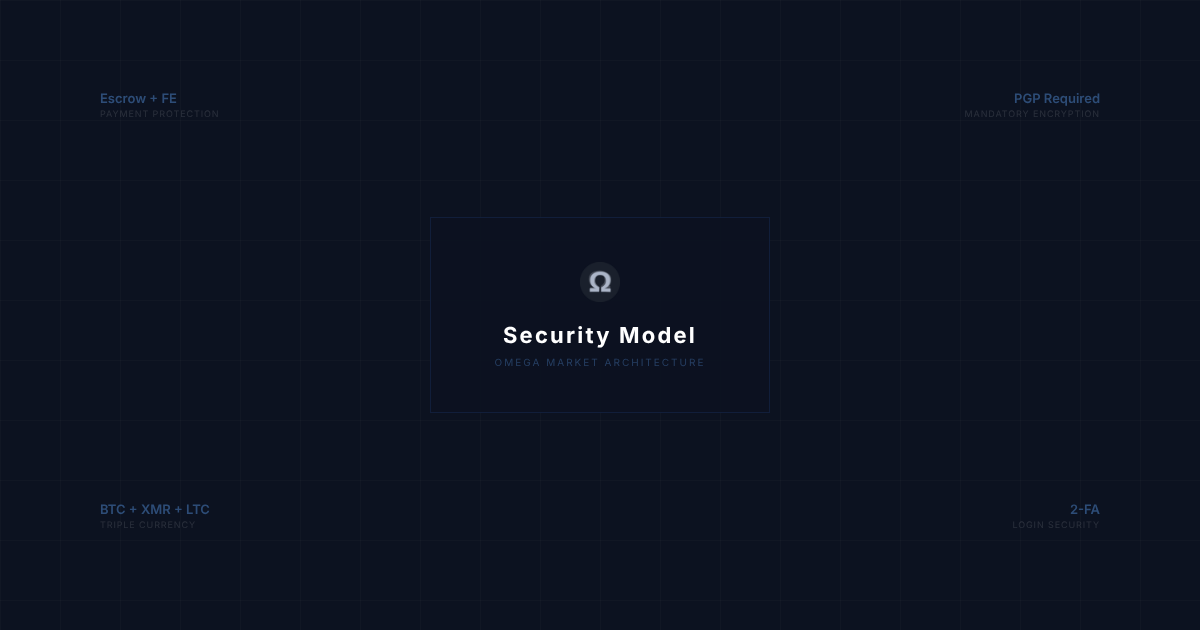
Every Omega Market account must register a PGP key and enable two-factor authentication. No exceptions. This immediately filters out users who cannot handle basic operational security, raising the overall trust level. Messages between buyers and vendors are encrypted end to end. The 2-FA adds a second verification layer that makes credential theft significantly harder.
Standard escrow holds funds until delivery is confirmed. Finalize-early is available for established vendors. The escrow is centralized — not multisig like Nexus — but Omega compensates with strict login requirements that reduce the attack surface.
Every account must register a PGP key and enable two-factor authentication at signup. No opt-out. Messages encrypted end to end. This places Omega alongside Nexus as the strictest platform for account security on the active darknet.
Standard escrow on all transactions. FE for established vendors with proven track records only. Centralized model — the platform controls the wallet. Dispute resolution through moderators with 24/7 support availability.
The platform publicly states harm reduction policies — a rarity in the darknet ecosystem. Combined with 24/7 support and active dispute resolution, this positions Omega Market as one of the more community-oriented services still operating.
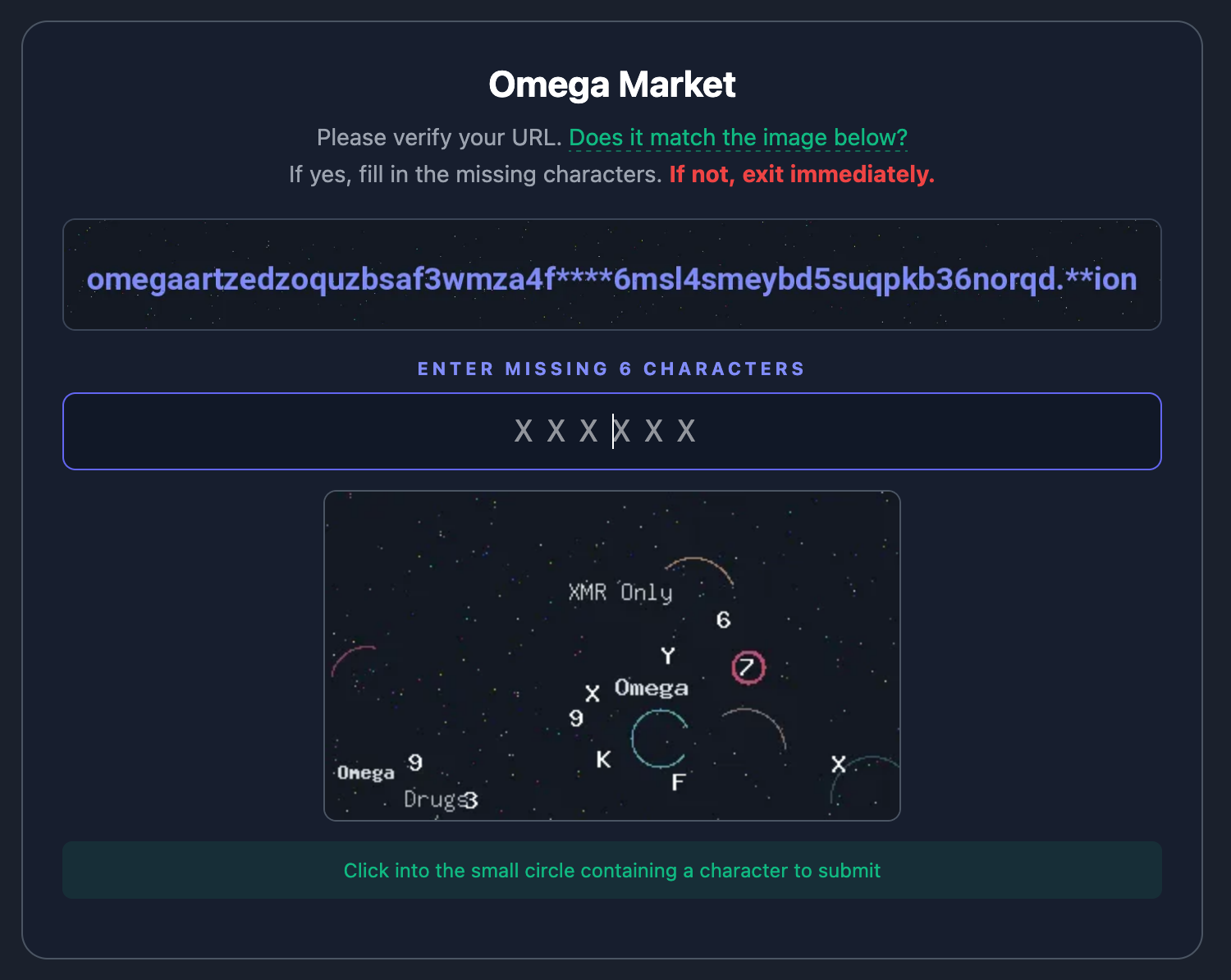
The Omega Market login includes a URL verification challenge more sophisticated than standard CAPTCHA. Users must verify the displayed onion address and complete a character-matching challenge. SOCRadar has documented phishing activity targeting the Omega link throughout 2026. The distinctive Ω branding is recognizable but easy to clone. Only trust the signed Dread thread.
A Tor-based darknet platform requiring PGP and 2-FA for all accounts. Accepts BTC, XMR, and LTC. Uses escrow and FE. Features harm reduction policies and 24/7 support.
Yes. Multiple v3 mirrors active. Strong Dread community presence. Regular admin updates. Verify status through the signed mirror thread.
Login includes URL verification challenge. Only trust the official signed Dread thread. The Ω branding is easy to clone — visual identification alone is not enough.
Bitcoin, Monero, and Litecoin — three currencies, more than most competitors. No auto-swap. Escrow on all orders. FE for established vendors.
Yes. No exceptions. You cannot create an account without registering a PGP key. Combined with mandatory 2-FA, Omega Market is one of the strictest for login security.
Both require PGP. Nexus has multisig 2/3 escrow (structurally stronger). Omega accepts LTC as a third currency and has harm reduction policies. Both above average for security.
Wang, Arief & Hernandez-Castro — International Journal of Information Security, 2025"Platforms that mandate PGP and 2-FA from registration show significantly lower rates of successful phishing attacks. The friction filters out casual users but builds a higher-trust community with better operational security practices."
Omega Market is one of two active platforms (alongside Nexus) mandating PGP for all users. SOCRadar's 2026 dark web report notes consistent growth and professional administration. DeepStrike Labs flags centralized escrow as the primary structural weakness — without multisig, exit-scam risk depends on administrative honesty.